Tribal Health Collective
Visit Prototype"Stories that heal, scaled."
The problem: grassroots tribal healthcare models that actually work rarely make it past the village they were built in.
Context & Problem
Tribal Health Collective (THC) is a photo-voice-led design system that turns first-person tribal healthcare stories into a national platform for awareness, advocacy, and policy change.
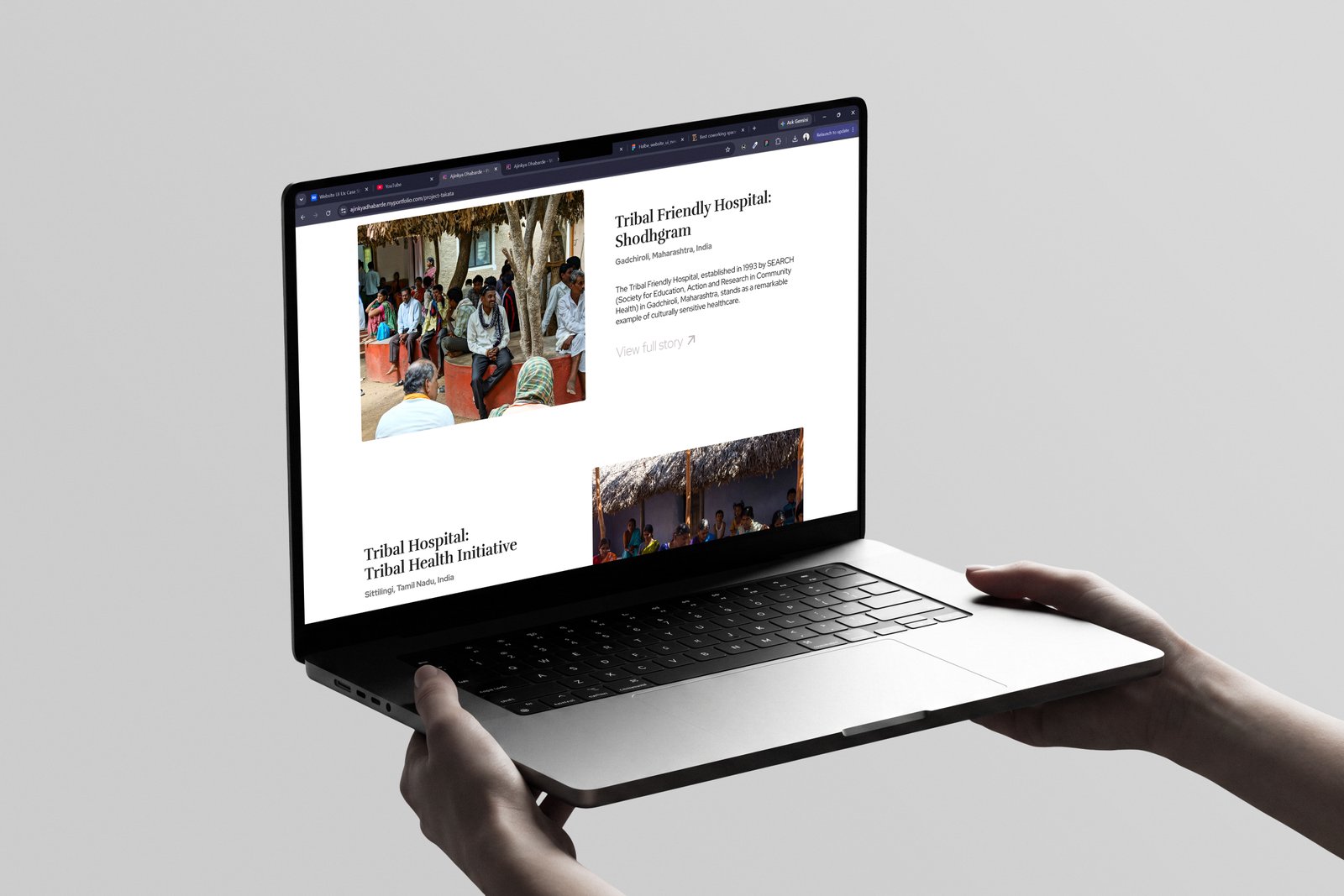
Grassroots healthcare models like Shodhgram (Gadchiroli, Maharashtra, founded 1993 by SEARCH) and Sittilingi's Tribal Health Initiative (Tamil Nadu) prove that culturally rooted, community-first healthcare works. But these successes rarely travel beyond the village they were built in.
THC exists to close that gap: collecting documented, photo-narrated success stories and turning them into a shared digital platform that policymakers, NGOs, and the public can discover, learn from, and act on.
"Successful tribal healthcare models rarely travel beyond the village they were built in."
What the project covered
- Responsive web platform showcasing photo-led tribal narratives
- Information architecture across 6 core sections: Home, About THC, Empower, Resources Hub, Media, Contact Us
- Stakeholder engagement layer for advocacy, donations, volunteering, and partnerships
- Resource and policy layer with policy briefs, funding portals, and a data hub
What constrained it
- Content depends on real photo-voice field research, a slow, trust-dependent human process
- Audience spans two extremes of digital literacy: rural tribal members and urban professionals
- Had to balance emotional storytelling with credibility for policy-level stakeholders
- Low-bandwidth and offline constraints across rural deployment regions
Make grassroots healthcare stories discoverable and emotionally resonant to non-tribal audiences.
Give tribal communities themselves a direct channel to advocate for their own health rights.
Convert storytelling into concrete action: donations, volunteering, partnerships, policy attention.
Turn individual wins into a documented, shareable playbook other communities and NGOs can act on.
| Structural Gap | Description & Impact |
|---|---|
| 1. Systemic Issues | Conventional healthcare frameworks often overlook cultural practice and community economics, so inequities persist even where models like Shodhgram and Sittilingi exist. |
| 2. Lack of Scalable Advocacy | Geographic isolation and the absence of community-led initiatives make it hard for tribal communities to advocate for their needs or shape policy. |
| 3. No Organized Platform | Without a shared platform to carry proven models forward, communities keep experiencing individual wins instead of widespread, replicable solutions. |
Research: Who & How
Around 5 to 10 people were involved in the field research behind this project: a mix of tribal community members and healthcare workers and experts. These weren't literal photo-voice sessions where participants took their own photos. They were interviews, documented with photographs, and the personas below come directly from those conversations.
Key Stakeholders: Three Groups, One Shared Outcome
| Stakeholder | Role | Value Delivered |
|---|---|---|
| Policy Makers | Drafting & applying | Design and implement policy inspired by real, documented success stories, ensuring healthcare reaches tribal areas effectively and respectfully. |
| Tribal Communities | Beneficiaries | Gain better access to healthcare, awareness, and confidence through the shared stories of others' success. |
| Organizations & Public | Community participation | Drive community involvement, deliver services, and bridge the gap between tribal populations and the wider healthcare system. |
Jitu Munda, 32
Mayurbhanj District, Odisha, India | Farmer & Daily Wage Laborer (Santal Tribe)
Challenges
Healthcare deserts (nearest hospital is 40 km away with no transport), severe financial barriers, and little awareness of preventive care or legal health rights.
Goals
Access reliable, affordable care for his village, educate his community on preventive measures, and advocate for healthcare infrastructure from local authorities.
Hears about the site, opens it, sees a photo story, reads the full narrative, recognizes a similar healthcare issue, discusses it with peers, and fills out the "Get in Touch" form.
Priya Sharma, 28
Mumbai, Maharashtra, India | IT Professional & Social Advocate
Challenges
Goals
Insight → Decision
What each finding actually changed in the design, not just what was concluded but what it caused.
Grassroots healthcare models that work rarely scale beyond their village.
Built one shared platform connecting multiple grassroots models (Shodhgram, Sittilingi) instead of documenting them as isolated case studies.
The audience spans two extremes: rural tribal communities and urban professionals with very different digital literacy.
Card-sorted the IA into 6 plain-language pillars, and leaned on photo-first storytelling that doesn't demand heavy reading to understand.
Both personas, Jitu and Priya, need an emotional connection before they'll act.
Structured stories to build empathy first, before ever asking for a donation, advocacy signature, or volunteer sign-up.
Usability testing showed people wanted the site in their own language, not just English.
Regional language support moved from a nice-to-have idea to a validated priority on the roadmap.
Structure & Flows
Card sorting condensed the content matrix into 6 primary categories, matching the site's actual top-level navigation.
Landing & Entry
Open website, loading screen, hero carousel, and direct narrative entry.
Story Discovery
Explore 5 photo stories, grassroots models (Shodhgram & Sittilingi), and tribal data.
Deep Engagement
Access policy briefs, download toolkits, and view media coverage.
Conversion & Action
Submit an inquiry, partner, donate, or volunteer.
Home
Photo Narratives- Tribal Story Spotlights (Photo + Text)
- Grassroots Voices
- Community Advocacy
About THC
Institutional Trust- Mission & Vision Statements
- Partners & Press Carousels
- Field Recognitions
Empower
Action Engine- Advocate & Volunteer Portals
- Partner Registration
- Donation Gateway
Resources Hub
Knowledge Base- Policy Briefs (External)
- Downloadable Toolkits
- Funding Portals & Data Hub
Media
Publicity Hub- Field Blogs & Updates
- News Carousel
- Press Articles & Coverage
Contact Us
Structured Form- Inquiry Form Schema
- Tribal Hospitals Map
- Support Hotline
Connects primary navigation routes (Home, About THC, Empower, Resources Hub, Media, Contact Us) with verified social channels (Facebook, Instagram, Gmail, X, LinkedIn).
Visual Identity
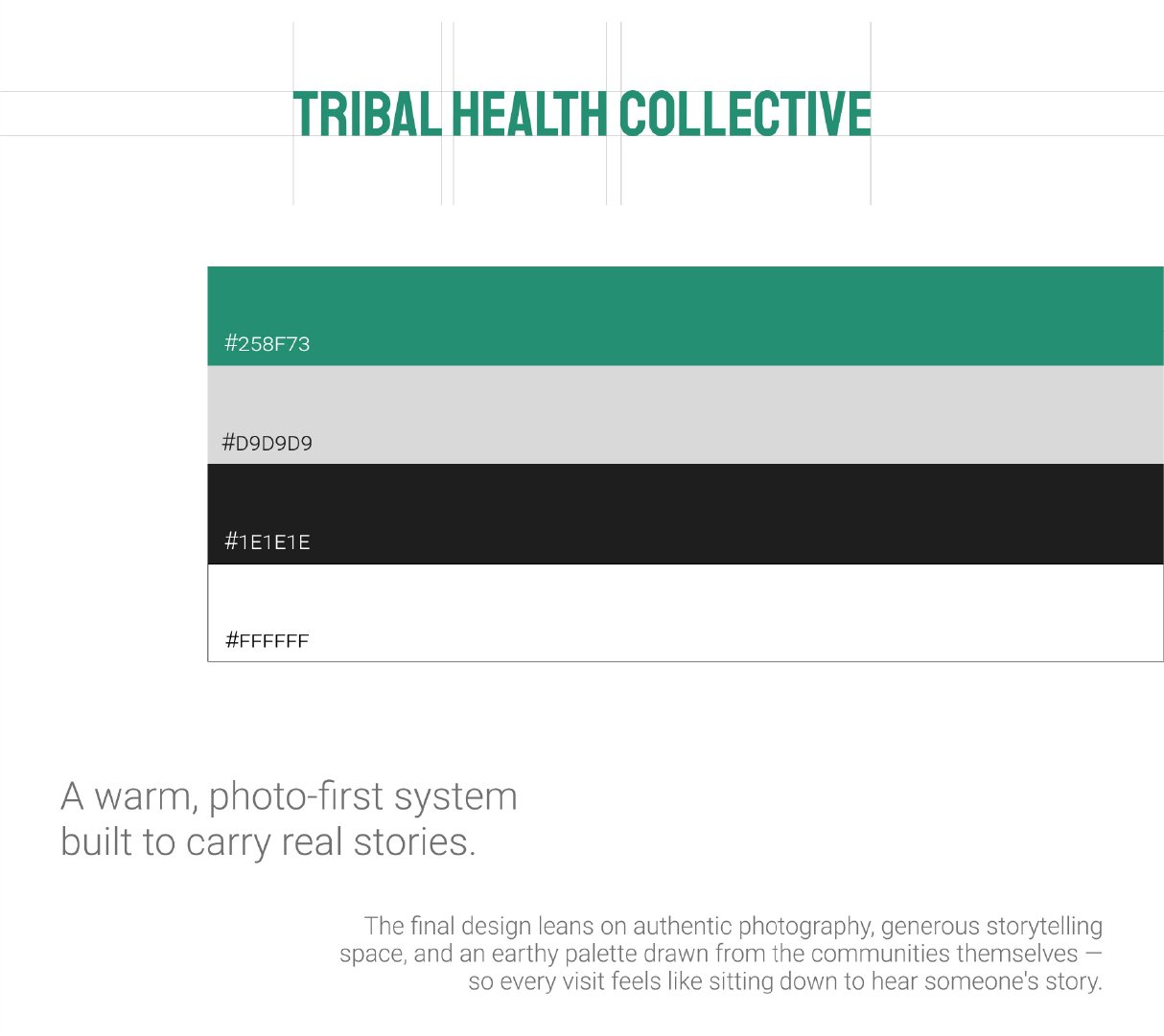
Positioning: "a warm, photo-first system built to carry real stories." The design leans on authentic photography, generous storytelling space, and an earthy palette.
Color Palette
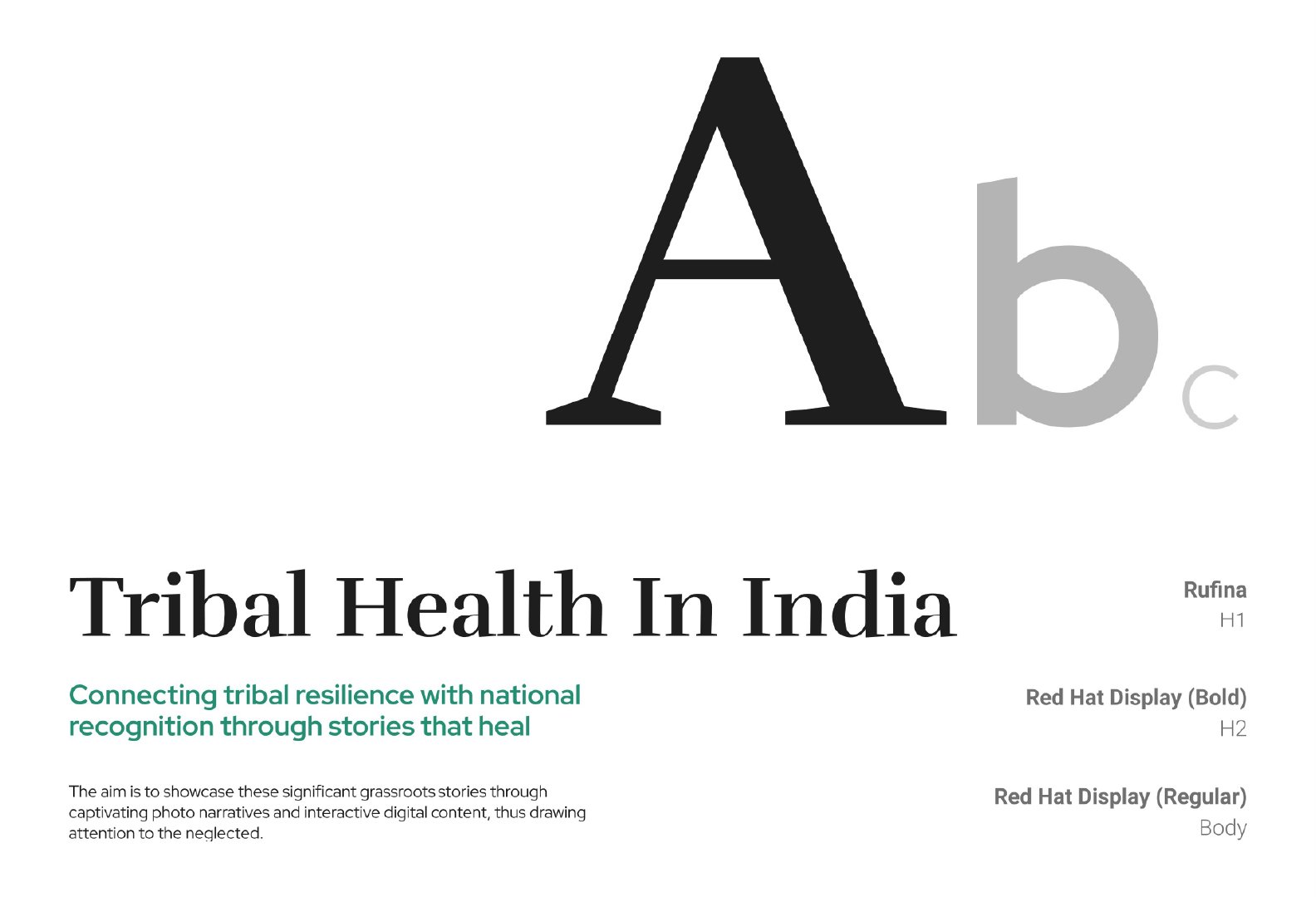
Typography Pairing
Design Walkthrough
Straight from the Figma file, this is where the structure above actually landed.
Home: photo-first, story-led
A scroll through the full home page: hero photo and mission line, an interactive map of where tribal communities are located, a nutrition data visualization, ways to get involved, and spotlighted success stories, all before any ask for donation or advocacy.
About THC: the trust page

Mission, Purpose, and Vision laid out plainly, backed by real partner logos and press coverage instead of just claims.
Empower: the action page
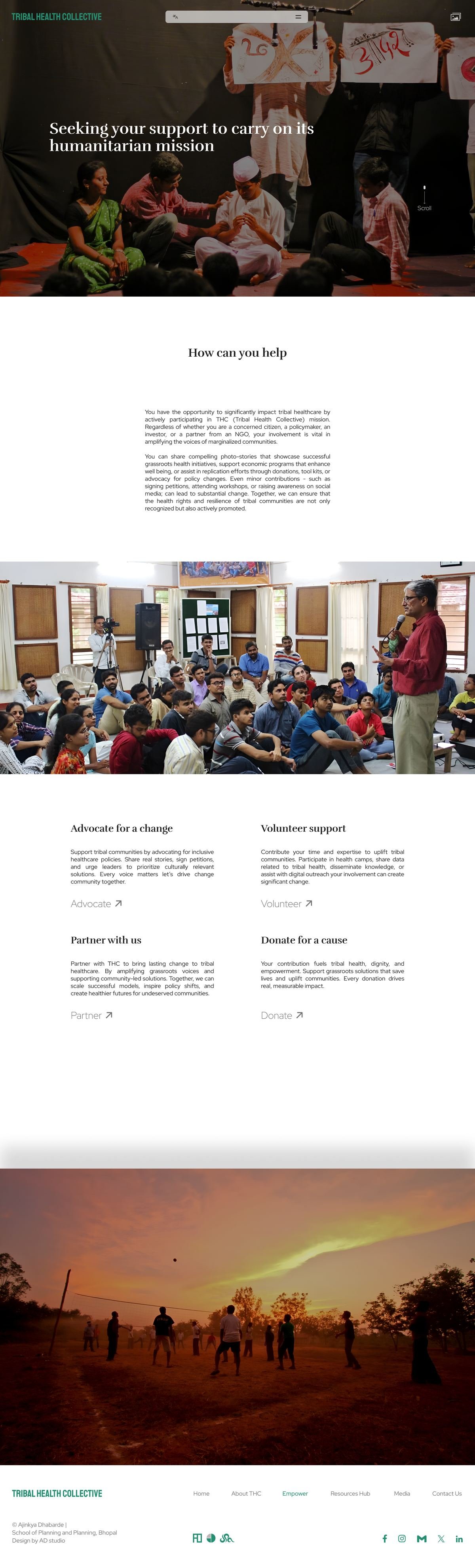
Four clear paths to act: Advocate, Volunteer, Partner, Donate, each explained before asking for a commitment.
Media: evidence over adjectives
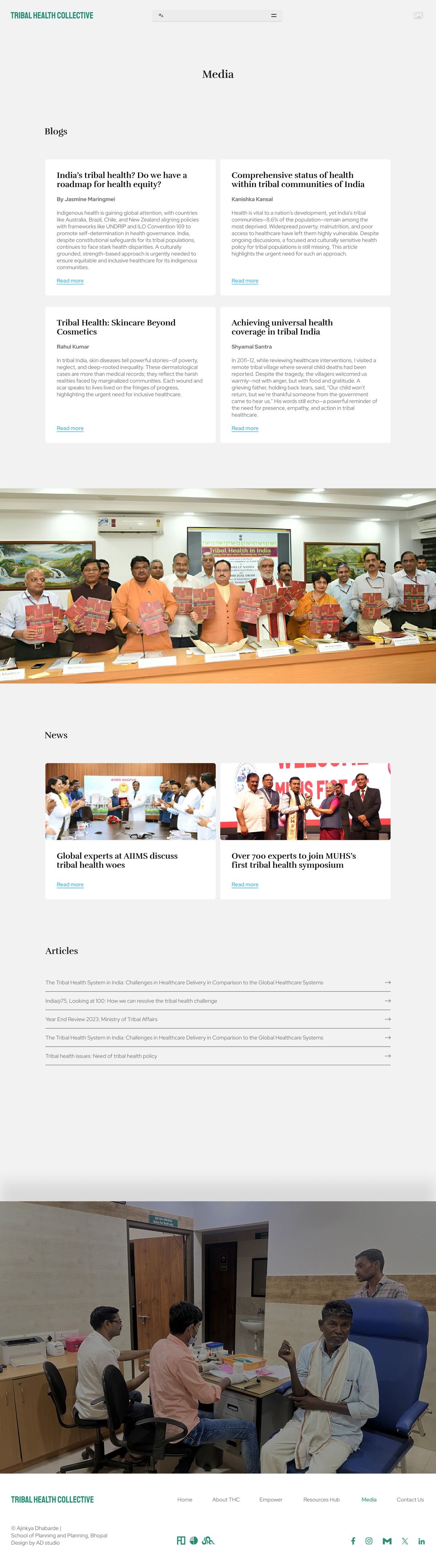
Real blog posts with named authors, the credibility layer for policy-minded visitors.
Contact Us: the intake form
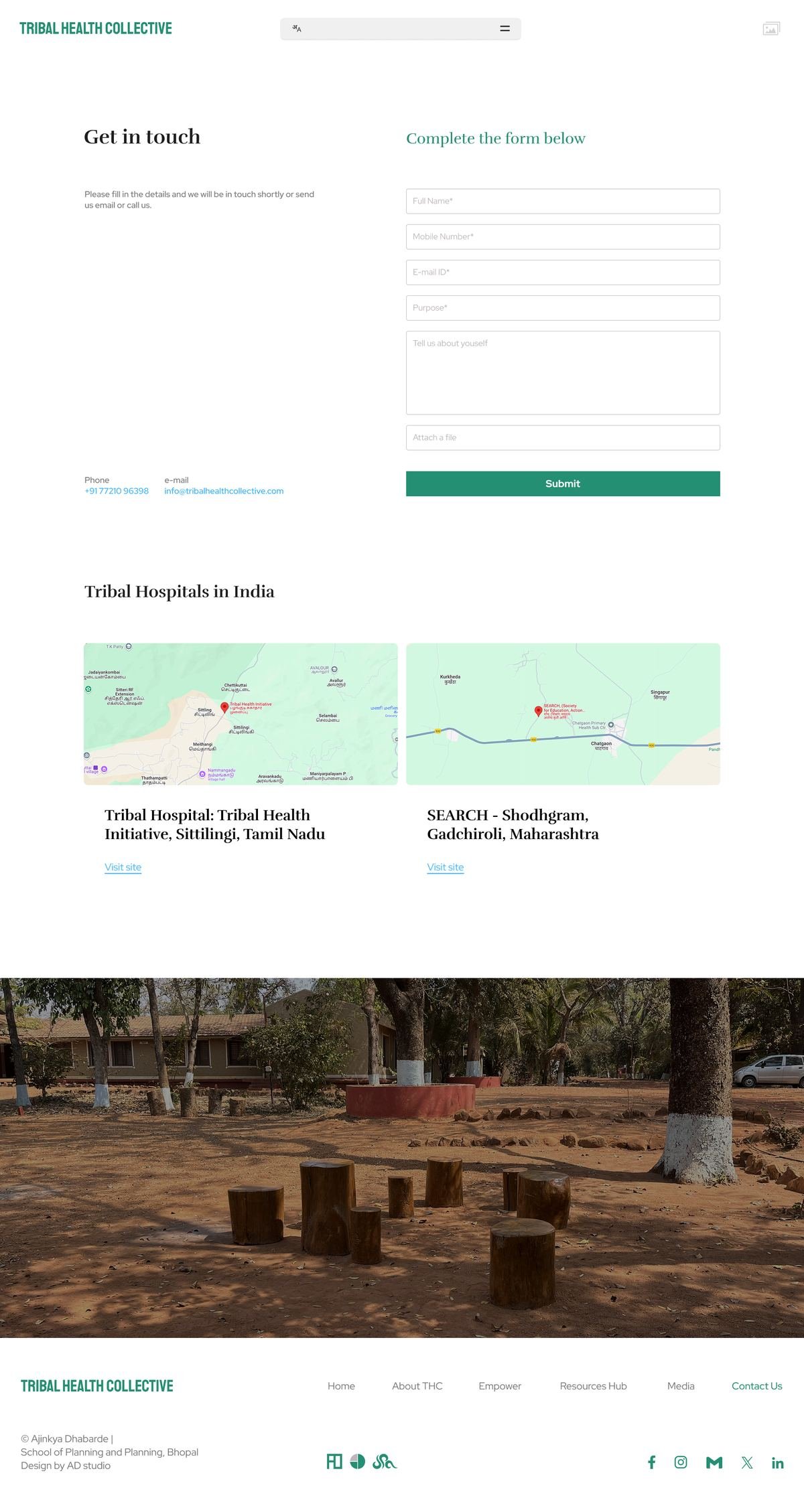
The structured intake form from the IA above, plus a real map linking out to the Sittilingi and Shodhgram tribal hospitals.
Validation
Usability testing covered two specific flows: the intake/contact form (advocate, volunteer, partner, donate) and the story-reading experience. Both worked well for the people who tried them.
The clearest finding: people wanted the site in a regional language, not just English. That moved regional localization from a speculative future idea to a validated priority.
Outcome
Delivered
CONFIRMED- Complete coded prototype delivered as SPA Bhopal capstone work (2024 to 2025)
- 6-pillar IA and story-led homepage built and tested end to end
- 5 flagship stories structured for launch, including Shodhgram and Sittilingi
Validated in Testing
VALIDATED- Intake form and story-reading flow both tested successfully with real users
- Personas grounded in actual field interviews, not just assumptions
- Regional language support confirmed as a real need, not a guess
Reflection
The field research and testing here were more grounded than I've managed on some other projects, and it shows in how directly the regional language finding fed back into the roadmap. If I revisited this today, I'd want to actually build that regional language layer instead of leaving it as a roadmap item, and I'd want a larger interview sample than 5 to 10 people before treating any single persona as representative of a community this large and varied.